EDUCATION · 21 September 2026 · 8 min read
Risk management for binary options: the money rules that keep you in the game
Good binary options risk management is not about predicting every trade. It is about protecting your account with small stakes, clear limits, and disciplined habits.
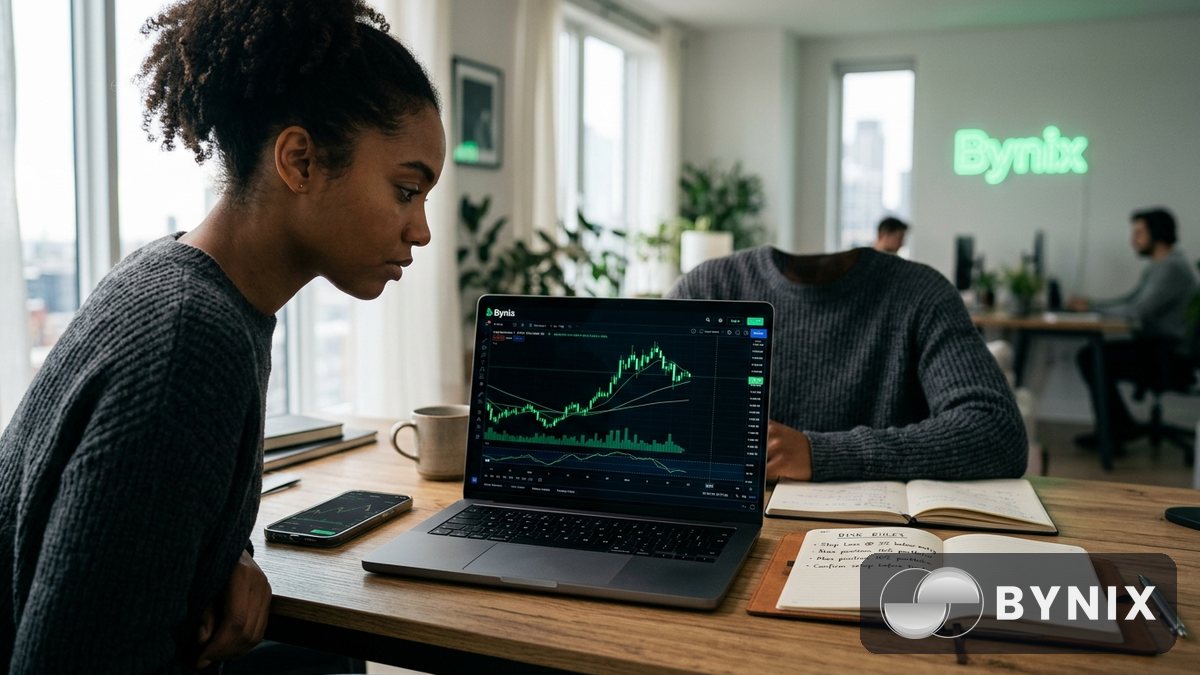
Risk management is the part of trading most beginners want to skip, and the part that usually decides whether they last a week or a year. In binary options, where each trade has a defined outcome, your edge is not just the signal you use. It is also how much you risk, how often you trade, and how you behave after a win or a loss.
If you want to stay in the game long enough to learn, grow, and improve, you need money rules that are simple enough to follow on your worst day. That means fixed stake sizes, a daily loss limit, a cap on trades, and a way to review what you are doing honestly. Platforms like Bynix Broker make that easier with fixed-amount entry, trade history, and account levels you can track in one place.
Start with the one rule that matters most: fixed stake size
A lot of traders make the same mistake early on: they size each trade based on feelings. After a win, they get confident and increase the stake. After a loss, they try to get it back fast. That emotional sizing is one of the quickest ways to damage an account.
A better approach is to use a fixed stake. Many traders work with 1–2% of account balance per trade. If you have a $500 account, that means risking about $5 to $10 per trade. If you have a $1,000 account, that means $10 to $20. The exact number is less important than the habit: keep it consistent.
Why fixed stakes work
- They stop one bad trade from hurting you too much.
- They make results easier to compare over time.
- They reduce emotional decisions.
- They help you recover gradually instead of gambling for a comeback.
On Bynix, this is practical because the platform supports fixed-amount entry, so you can set a trade size and stay with it instead of changing the amount every time your mood changes. If you are still building discipline, you can also practise on the free demo account and treat it like a real account.

Put a daily loss limit before the market does it for you
A daily loss limit is your seatbelt. It keeps a bad session from turning into a disaster. The idea is simple: when you lose a set amount in one day, you stop trading for the day.
For many traders, a sensible starting point is 3–5% of account balance per day. So if your account is $500, your daily stop might be $15 to $25. Once you hit that limit, you close the platform and step away.
That may feel strict, but it solves a real problem: revenge trading. After a loss, people often want one more trade to get it back. That usually leads to more losses because the decision is emotional, not logical.
A simple daily structure
- Pick your risk per trade, such as 1%.
- Set a daily maximum loss, such as 4%.
- Decide the maximum number of trades per session.
- Stop trading when you hit any of those limits.
The point is not to trade all day. The point is to trade well enough to survive long enough to improve.
Limit the number of trades and keep a journal
More trades do not automatically mean more progress. In fact, overtrading is one of the biggest account killers. If you take too many setups, you start forcing trades, reading too much into small patterns, and giving back your best gains.
A useful rule is to set a maximum number of trades per session. For example, you might allow yourself 3 to 5 trades in one session and then stop, win or lose. That keeps your focus high and reduces impulse entries.
Just as important is a trading journal. You do not need a complicated system. A simple notebook, spreadsheet, or notes app is enough if you are honest.
Write down:
- date and time
- asset traded
- expiry time
- CALL or PUT
- stake size
- reason for entry
- result
- emotional state before the trade
Over time, your journal shows patterns that memory hides. You may discover that you lose more after late-night trading, or that you perform better on major forex pairs than on random setups. You may also notice that your best trades happen when you wait patiently and your worst trades happen when you rush.
Tip: if you would not be comfortable showing the trade to another serious trader, it probably belongs in the journal as a lesson, not a habit.
Understand the maths of recovery before you size up
One of the most dangerous ideas in trading is the fantasy of “just win it back.” Recovery is possible, but it is never free. The deeper the drawdown, the harder the climb.
Here is the basic truth: if your account falls by 10%, you do not need just 10% to get back to breakeven. You need more, because you are recovering from a smaller base. A 20% loss requires a 25% gain to recover. A 50% loss requires a 100% gain.
That is why the goal is not to avoid all losses. Losses are part of trading. The goal is to keep losses small enough that recovery stays realistic.
A healthier recovery approach
- Reduce stake size after a bad day.
- Return to demo if your confidence is shaky.
- Review your journal instead of increasing risk.
- Rebuild with clean, simple setups.
- Only increase size after consistency returns.
Bynix can help with that reset process. If you need a confidence rebuild, use the demo account and practise with the same charting tools, timeframes, and trade types you use live. The platform also gives you a visible account level and trade history, which makes it easier to see whether your behaviour is improving, not just whether the last trade won or lost.
Use emotions as a warning sign, not a trading signal
Good risk management is not only mathematical. It is emotional too. Most account damage happens when traders feel impatient, angry, bored, or overconfident.
Common warning signs include:
- increasing stake after a win because you feel unstoppable
- doubling down after a loss because you want closure
- trading outside your plan because you are bored
- switching assets constantly because one chart feels “dead”
- taking random CALL or PUT trades just to stay active
The discipline you need is simple but not easy: when emotions rise, size should fall. If you are tired, distracted, or frustrated, trade less or stop. A calm trader with a modest edge will usually outlast a stressed trader with a bigger “idea.”
Bynix’s 24/7 access means the market is always open somewhere, but that does not mean you should be. Your job is not to trade every hour. Your job is to take the best trades within your risk rules.

How to turn risk rules into a repeatable routine
A routine makes discipline easier because you are not deciding everything from scratch every day. You are following a process.
A practical routine for most traders
- Review your account balance and set your stake.
- Mark your daily loss limit.
- Choose the maximum number of trades for the session.
- Check the chart and wait for only your best setup.
- Log the trade before and after entry.
- Stop when your limits are hit.
- Review results at the end of the day.
If you are still learning, you can practise this routine on the demo account. If you are ready to trade live, you can register here and apply the same rules from the first deposit. If you want to work with funded capital later, Bynix also offers funded accounts, which can be useful for traders who want a structured path with clear rules.
You can also use your journal to decide whether you are ready for a bigger step. If your trade sizes, timing, and emotional control are inconsistent, the answer is usually to slow down, not scale up.
Risk management is not a restriction on success. It is the structure that makes consistent learning possible. Keep the stakes small, set a daily stop, limit the number of trades, and review your decisions honestly. That is how you give yourself more chances to improve.
Binary options trading involves real risk and can lead to loss of the invested amount. Trade only with money you can afford to lose, and use risk controls on every session.