EDUCATION · 3 October 2026 · 7 min read
Binary options basics: CALL, PUT, expiry and payout explained for beginners
Learn the basics of binary options trading: what CALL and PUT mean, how expiry and payout work, how to read a simple candlestick chart, and why demo practice matters first.
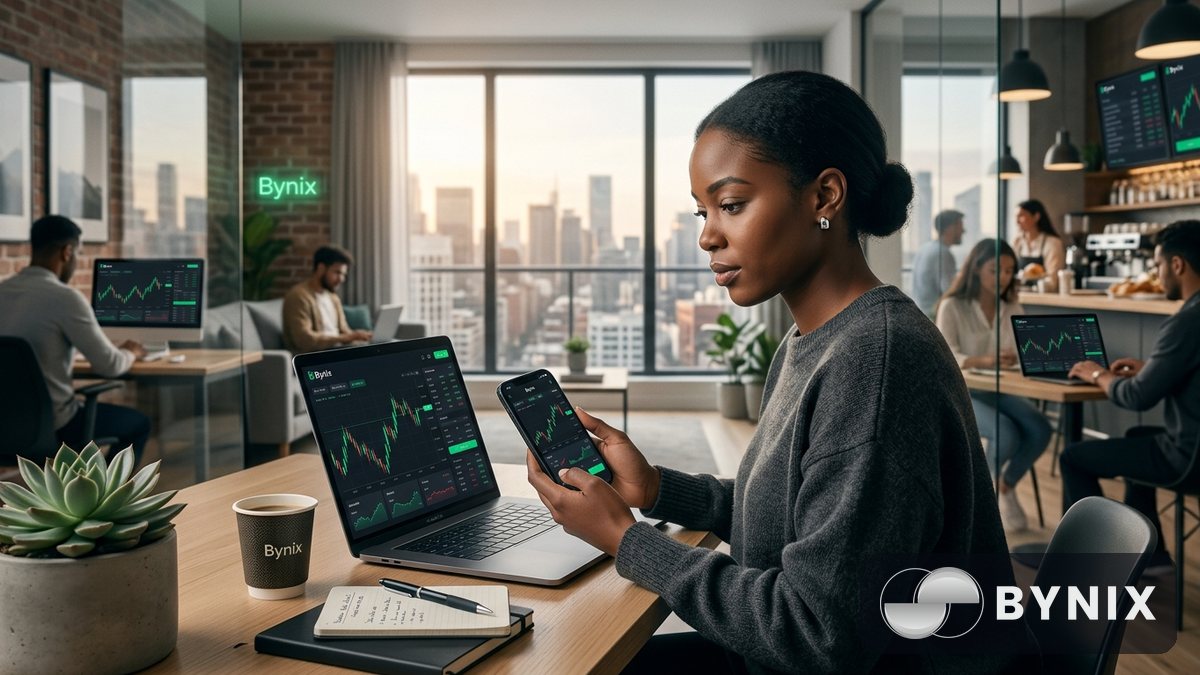
What a binary option is in simple terms
A binary option is a straightforward trading contract with only two possible outcomes at expiry: you either predict the price direction correctly and receive a fixed payout, or you do not and lose the amount you put into the trade.
That’s why beginners often like binary options: the decision is simple. You choose whether you think the price will end higher or lower than the current level by the time the trade expires. On Bynix, this is done with CALL and PUT trades, and expiries can range from 5 seconds to 1 day.
Here is the basic idea:
- CALL means you expect the price to finish above the entry price at expiry.
- PUT means you expect the price to finish below the entry price at expiry.
- If your direction is correct at the exact expiry time, the trade settles in your favour.
- If not, the trade expires as a loss of the stake.
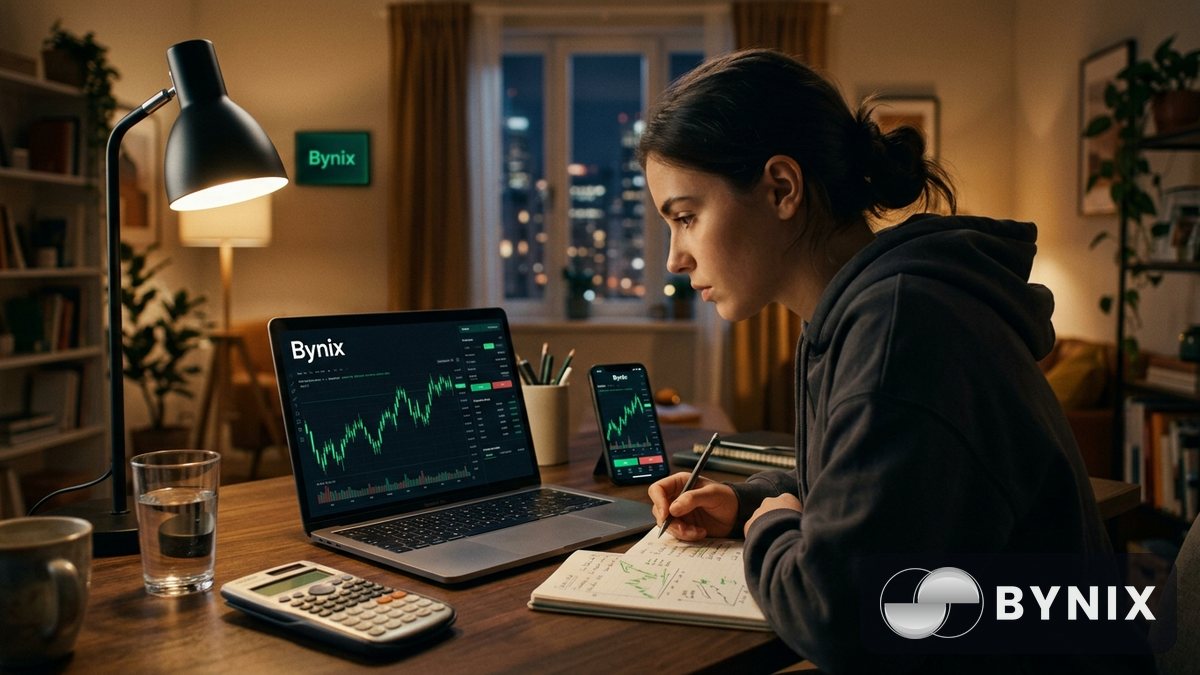
Because the outcome is fixed in advance, binary options are easy to understand, but they are still fast-moving and risky. That is why it helps to start small and practise first on a free demo account, which comes with $10,000 in virtual balance and can be topped up any time.
CALL vs PUT, expiry and payout explained
CALL and PUT
Think of a CALL and PUT as a yes/no question about price direction.
- You look at the current market price.
- You decide whether price will be above or below that level when the trade ends.
- You choose CALL if you expect a rise, or PUT if you expect a fall.
This applies across Bynix’s 140+ OTC markets, including forex majors, crosses, exotics, crypto, gold, silver, oil, commodities, indices and US stocks.
Choosing an expiry
The expiry is the moment your prediction is checked. On Bynix, expiries range from 5 seconds to 1 day.
Short expiries can be useful when the market is moving quickly, but they also leave very little room for error. Longer expiries give the chart more time to develop, but the market can change direction several times before settlement.
A practical beginner approach is:
- Use longer expiries first while learning chart behaviour.
- Watch how price reacts around recent highs and lows.
- Avoid random entries just because a chart is moving.
- Match the expiry to the pace of the market you are trading.
How payout works
Binary options payouts are usually shown as a percentage of your stake. On Bynix, payouts can go up to 95% depending on the market and conditions.
For example:
- Trade size: $10
- Payout: 92%
- If you win: you receive $9.20 profit plus your original $10 stake back
- If you lose: you lose the $10 stake
So the payout percentage tells you the potential profit, not the total amount returned.
A simple way to read it:
- Win = stake back + payout profit
- Loss = stake is deducted from your balance
Tip: Before placing any live trade, check the payout displayed for that market and expiry. A higher payout can improve the maths, but it does not reduce the risk.
OTC markets and why they are open 24/7
You will often see the term OTC on binary platforms. OTC stands for over-the-counter, meaning the pricing comes from an internal market feed rather than a traditional exchange session. This is one reason OTC markets can stay available 24/7, including weekends.
On Bynix, OTC access means you can trade many instruments at almost any hour, which is useful for people in different time zones — from Bangladesh and India to Nigeria, Brazil, Europe and across LatAm.
That matters because real life does not follow one market schedule. A trader in Dhaka may want to check a crypto setup late at night, while someone in Lagos or São Paulo may prefer a quick trade outside local stock market hours.
Bynix also anchors its crypto pricing to live CoinMarketCap data, which helps keep the trading experience aligned with the wider crypto market movement.
A beginner’s look at the candlestick chart
You do not need to become a technical analyst overnight, but you should understand the basics of a candlestick chart before trading.
Each candle shows a time period and tells you four things:
- Open: where price started
- High: the highest point reached
- Low: the lowest point reached
- Close: where price ended
A candle can be green or red depending on whether price closed above or below the open, though colour settings can vary.
What to watch first
Start with simple ideas:
- Trend direction — is price generally moving up or down?
- Recent support and resistance — where has price paused before?
- Strong candles — are buyers or sellers showing pressure?
- Wicks — long wicks often show rejection of a price area.
When price keeps bouncing from the same area, that area may matter for your CALL or PUT decision. If price is already stretched after a fast move, chasing it can be dangerous.
Keep indicators simple
Many platforms overload beginners with indicators. Bynix gives you a clean charting environment with 11 timeframes, 20 indicators and 19 drawing tools, but you do not need to use everything at once.
A cleaner first setup could be:
- one trend tool
- one support/resistance line
- one momentum indicator if needed

The goal is not to make the chart look clever. The goal is to make the decision clearer.
Break-even maths and why the demo matters
A common beginner question is: “How often do I need to win to be profitable?” The answer depends on the payout.
Break-even example
If your payout is 92%, then each win earns $0.92 for every $1 risked, while each loss costs $1.
A rough break-even win rate is:
- 100 / (100 + payout%)
For a 92% payout, that is:
- 100 / 192 = about 52.1%
That means you would need to win a little over half of your trades just to break even, before considering poor trade selection, emotion, or overtrading.
A quick example:
- 10 trades of $10 each
- 6 wins at 92% payout = $55.20 profit
- 4 losses = $40 loss
- Net result = $15.20 profit
This is only an illustration, not a promise. Different payouts change the break-even level, and real trading outcomes vary.
Why practise first
Before risking real money, use the demo account. It lets you practise:
- choosing CALL or PUT
- testing expiries from seconds to longer time frames
- reading candles and market rhythm
- understanding how payouts affect results
- learning how your own timing feels under pressure
If you are ready to go live later, you can register and start with a small amount. Bynix supports a low entry point, instant deposits, fast withdrawals and quick verification, which makes it easier to move from practice to live trading once you are comfortable.
You can also explore Bynix Funded Accounts if you want a challenge-based path with defined rules, or the affiliate programme if you are interested in referring others.
Binary options become much easier to understand once you separate three things: direction, expiry and payout. Learn those first, then move slowly and keep your risk small.
Binary options trading involves risk, and you can lose the amount you invest. Trade carefully, practise first, and never risk money you cannot afford to lose.